
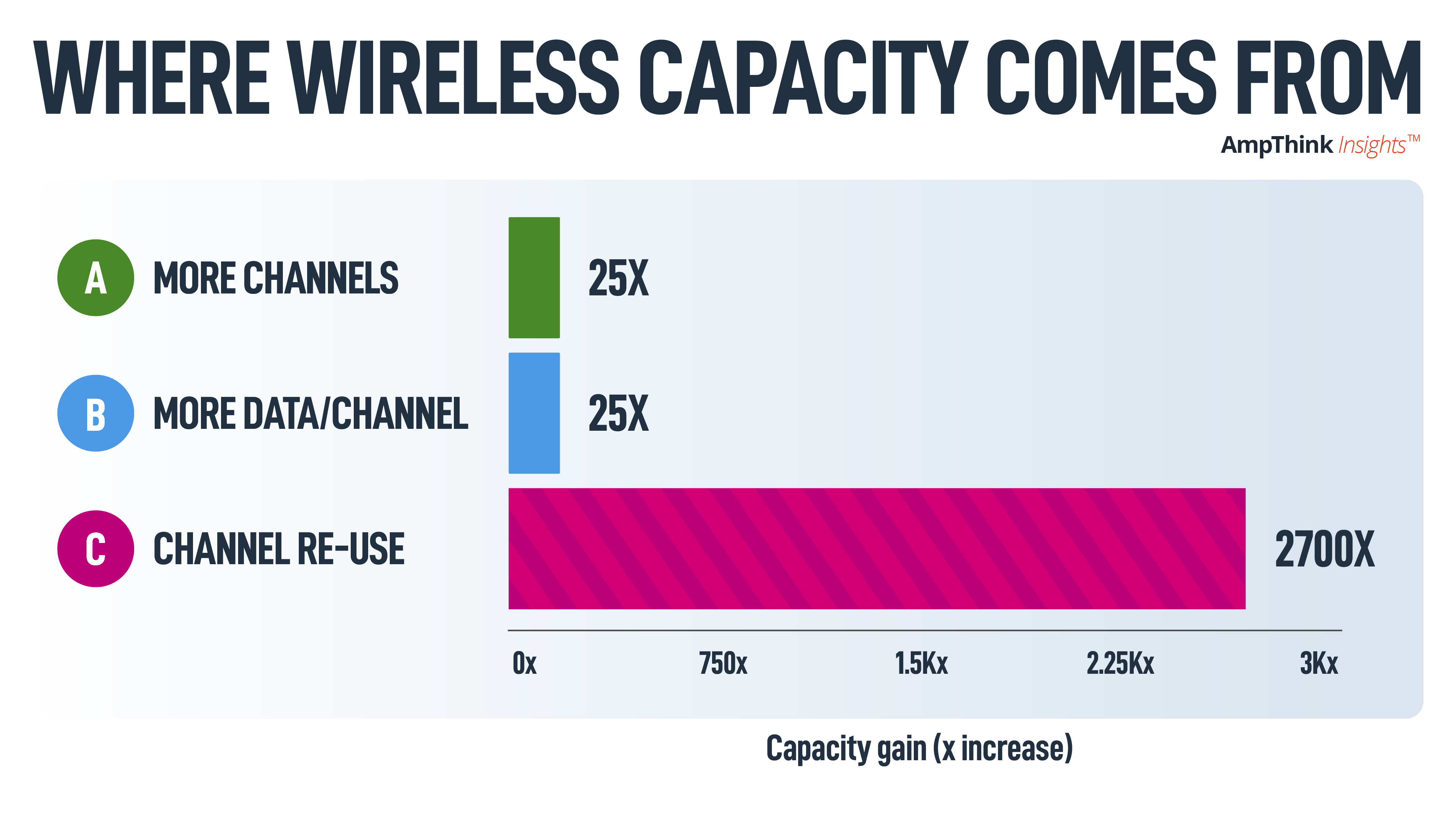
Stadium owners need confidence that their wireless networks can keep pace with growing demand. More spectrum helps. Newer standards like Wi-Fi 7 help. Future cellular advances will help. Yet when wireless capacity gains are broken down mathematically, more spectrum and better modulation have not been the largest sources of growth. The biggest gains have come from using the same finite channels again and again in smaller, better-isolated areas.
That point comes from the history of wireless itself. Martin Cooper, the engineer best known for leading the team that created the first handheld cellular phone, has argued that wireless capacity has increased roughly one trillion-fold since the early 1900s. That enormous number is not explained mainly by more spectrum or better modulation. Those advances each account for about a 25x improvement.
The much larger gains came from re-using the same spectrum more efficiently across smaller coverage areas. A separate analysis by Andrews, Zhang, Durgin and Gupta attributed roughly a 2,700x capacity gain from 1950 to 2000 to this same principle. Engineers call it spatial re-use. For owners, the simpler term is channel re-use.
The implication is most important inside stadiums. A seating bowl concentrates tens of thousands of devices into one dense environment. To keep pace with growing demand, the capacity strategy cannot rely only on adding radios, adding spectrum or waiting for the next standard. It has to increase how often the same channels can be used repeatedly across the bowl without interference.
This is why hyper-directional design is the gold standard for wireless connectivity in sports. By focusing RF energy into smaller, better-isolated seating areas, hyper-directional antennas enable increased channel re-use, creating more usable capacity from the spectrum a venue already has.

Garland, TX 75042