
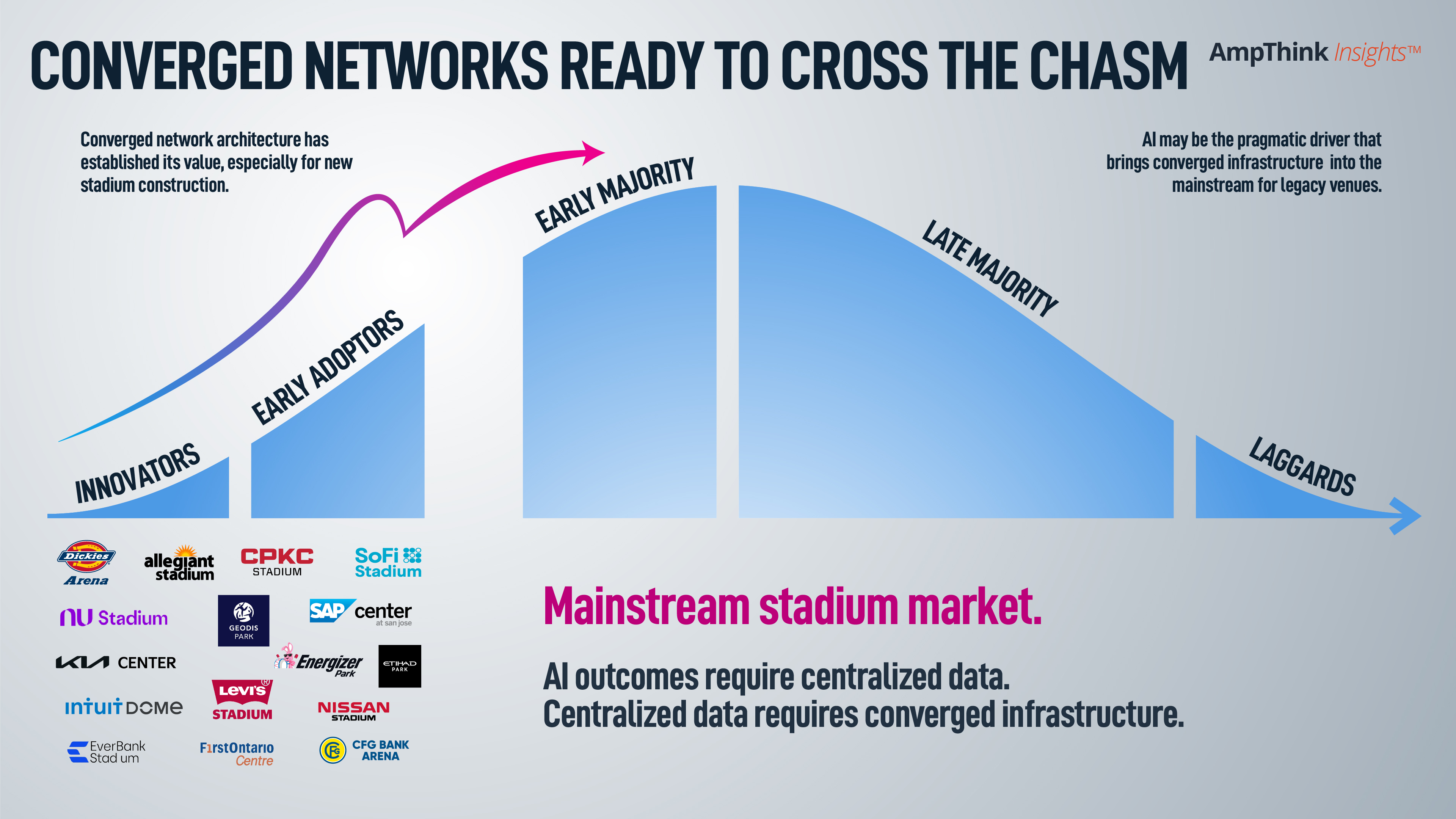
If Geoffrey Moore's model is right, converged stadium networks may be approaching the point where they cross the chasm.
First introduced in the early 1990s, Moore's framework explains how technologies move through four stages: innovators, early adopters, the early majority, and the late majority. The hardest step is the transition into the early majority, where adoption only happens for clear, pragmatic business reasons.
That distinction matters in stadiums. Early adopters of converged networks, primarily new builds, had a pragmatic reason: efficiency. A single shared infrastructure reduced duplication, lowered construction cost, and simplified operations. A small number of existing venues followed, but for most legacy stadiums, the equation is different. Convergence in an operating building is more difficult, more disruptive, and easier to defer. So, while the model is proven, the broader market has not moved. Perhaps this is because the benefit has not outweighed the perceived risk. That is exactly the condition Moore describes at the edge of the chasm.
What changes markets is not better technology. It is a new business requirement. AI may be that requirement.
Stadium owners want what AI is promising: automated operations, higher venue utilization, and new revenue through personalization and sponsorship. But AI depends on one thing above all else: data. Not just more data but connected data. Legacy stadiums were built on parallel systems. Each system collects data, but little of it is shared. The building can see individual signals, but not the relationships between them. That limits what AI can do.
Converged infrastructure solves that problem. It creates an environment where data from across the venue can be accessed, analyzed, and acted on together. In that sense, convergence is not just an efficiency strategy. It becomes the condition that allows AI to deliver meaningful economic outcomes.
Which reframes the decision for existing venues. Owners should not be asking "is convergence more efficient?" but "can we fully realize AI without it?" If the answer is no, the risk shifts. And that is typically when technologies move from optional to necessary, and when markets cross the chasm.

Garland, TX 75042