
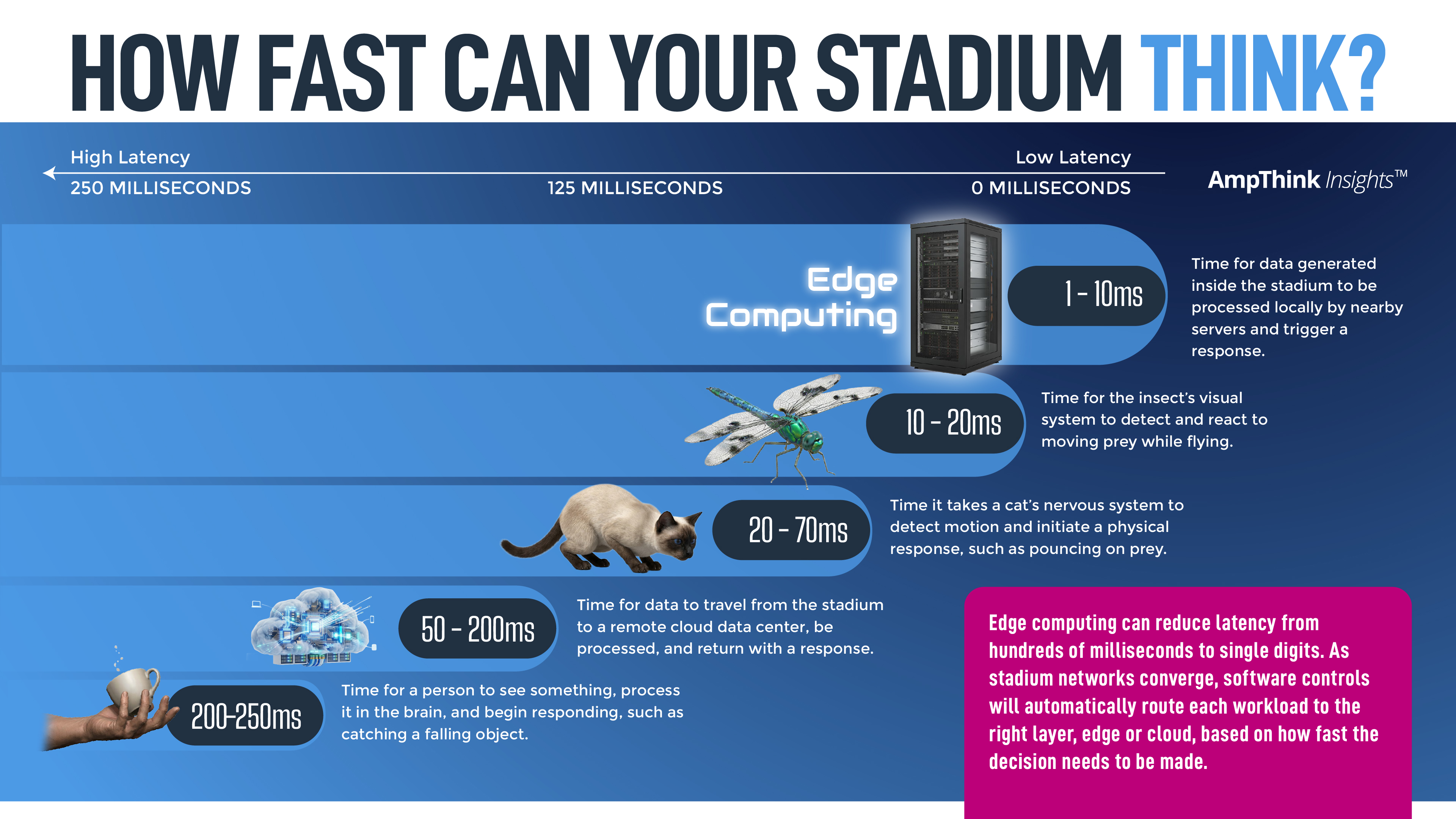
Every system that processes information and acts on it has an inherent delay. Biological or digital, the constraints are the same: how far does the signal have to travel, how much data is moving, and how much processing power is waiting at the other end. That delay is called latency, and in the age of AI, it will determine how much edge computing belongs in your stadium.
Five years ago, edge computing was a niche concept. Today it's growing at roughly 28% annually, faster than cloud. In Accenture's global survey of 2,100 C-suite executives across 18 industries, 83% said edge computing will be essential to staying competitive, and 81% said waiting too long will lock them out of its full benefits. That shift didn't happen gradually. It happened when AI started moving from generating reports to triggering actions, and the physics of cloud computing couldn't keep up without help from the edge.
In a typical use case, a cloud round trip from a stadium could take 50 to 200 milliseconds. Edge compute (hardware deployed close to where data is generated, rather than in a central location) could respond in 1 to 10ms. That's 20 to 200 times faster, primarily because the decision happens at or near the point where the data was collected.
Dynamic pricing that responds before a fan walks away. Access control that flags an anomaly before the turnstile opens. Crowd monitoring that escalates before a situation develops. HVAC and staffing that adjust in real time. These decisions happen all around the stadium, and they are moving into a time domain where neither cloud nor human intervention is fast enough. The loop closes in milliseconds.
But edge compute alone doesn't solve the full problem. A modern stadium runs dozens of independent systems: access control, point of sale, audio, video, HVAC, ticketing, Wi-Fi, each generating data or responding to signals in different formats. Adding edge compute to a fragmented network just creates faster silos. For AI to act on the full picture, the network has to be converged: shared infrastructure with software controls that normalize data across systems and route it to the right point for analysis. Edge without convergence is fast but blind. Convergence without edge is organized but slow.
Cloud isn't going anywhere. It's where you train models and do long-horizon analysis. Edge is what you add when the decision can't wait. The question is whether the network underneath your building is designed for a world where the most consequential decisions are being made faster than a dragonfly catches its prey.
AI is moving from analysis to action. That makes latency a business variable. Edge computing and converged networks are how stadiums will learn to think faster.

Garland, TX 75042