
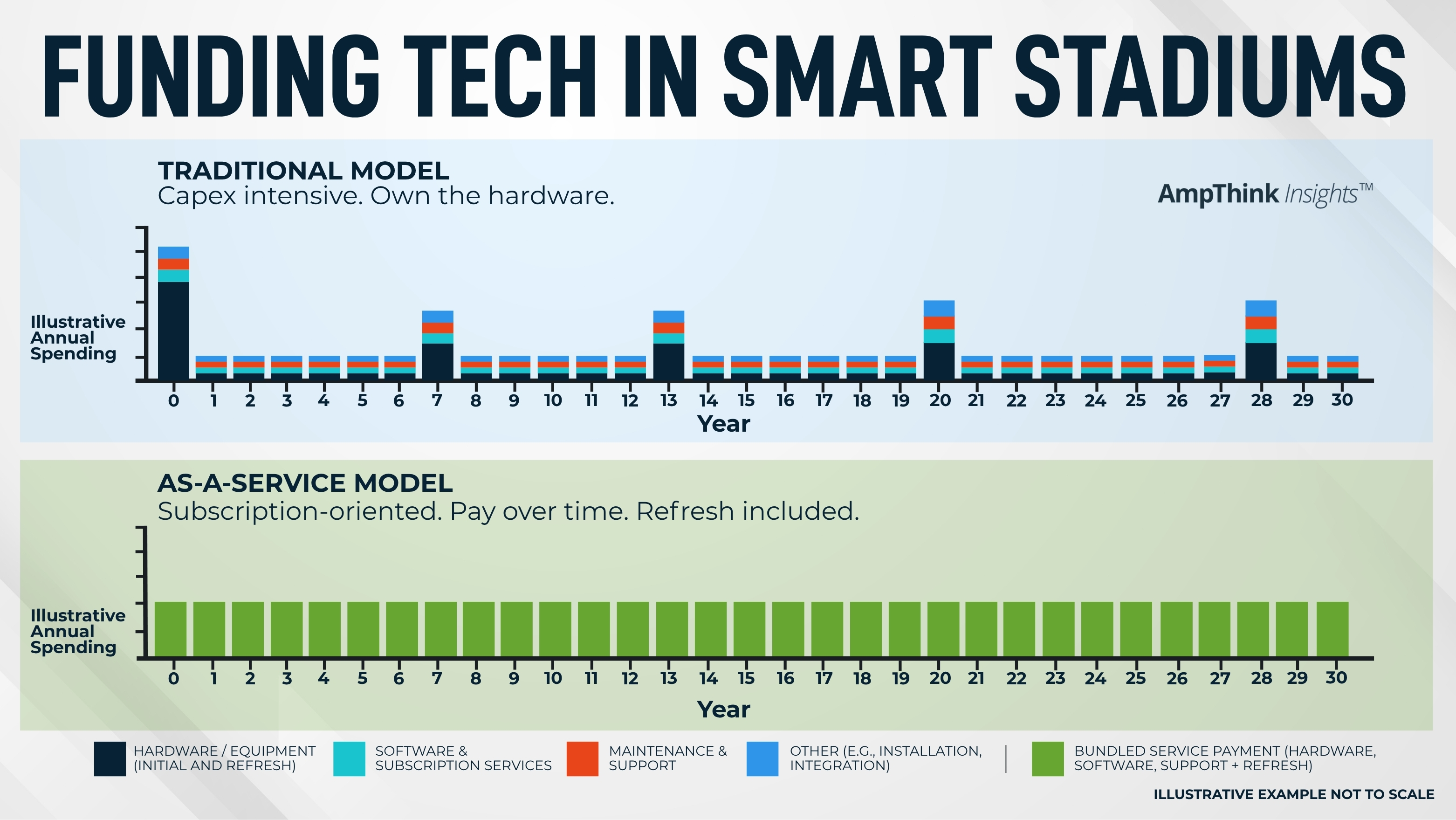
These days around $2 billion worth of technology gets built annually into new stadiums under construction. Traditionally, owners have funded that technology as capital expenditure: buy the equipment, own it, operate it and periodically replace it as systems become obsolete. That is no longer the only option. Across the technology industry, manufacturers are increasingly offering hardware, software, support and lifecycle services through subscription and as-a-service models. The shift reflects changes in how technology is delivered, but also in how technology companies make money. Recurring revenue is more predictable than periodic equipment sales, giving manufacturers a strong economic incentive to develop these offerings.
The distinction could become important for stadium owners because traditional infrastructure and technology operate on very different clocks. A building may be expected to operate for 30 years or more. Much of its technology will need to be upgraded or replaced several times during that period.
Consider a hypothetical $1 billion stadium with $100 million of technology at opening. Assume annual technology operating costs begin at $5 million and major portions of the technology estate require approximately $30 million of refresh investment every seven years. Over 30 years, those expenditures could total approximately $550 million. The precise number is less important than the pattern: a large initial investment followed by decades of operating expenses and periodic capital requirements.
Now imagine an alternative. Instead of buying and managing the technology itself, the owner contracts with a provider to supply, support and periodically refresh the technology through recurring payments. A truly comprehensive stadium-wide offering of this kind is not common today, so this is a hypothetical. But individual technology categories are already moving toward this model.
Over 30 years, those payments could add up to substantially more than the owner would spend under the traditional model. That does not necessarily mean the service model costs more in economic terms. The owner avoided a large initial capital investment and deferred much of its spending for years or decades. Finance teams account for that difference through concepts such as net present value: money spent well into the future is not economically equivalent to money spent today.
The economics will look different for every owner. An owner with available capital may prefer to buy equipment outright, retain control and avoid financing costs. Another may place greater value on preserving capital during construction, creating more predictable annual expenses and transferring some responsibility for keeping technology current to a service provider.
As tech spending grows, and stadium lives shorten, we expect to see financing tech become increasingly creative as owners make the choices that suit them best.

Garland, TX 75042