
Lately the technology conversation in sports is dominated by two letters: AI.
Executives want to know what it will mean for security, fan engagement, staffing, operations, and the bottom line. Vendors are racing to position themselves as AI-enabled. Consultants are sketching roadmaps. Investors are circling.
But while the spotlight is on AI, there’s a quieter story unfolding underneath, one that may determine whether AI ever delivers on its promise inside stadiums at all.
It’s another two-letter story. It is about IP, aka Internet Protocol.
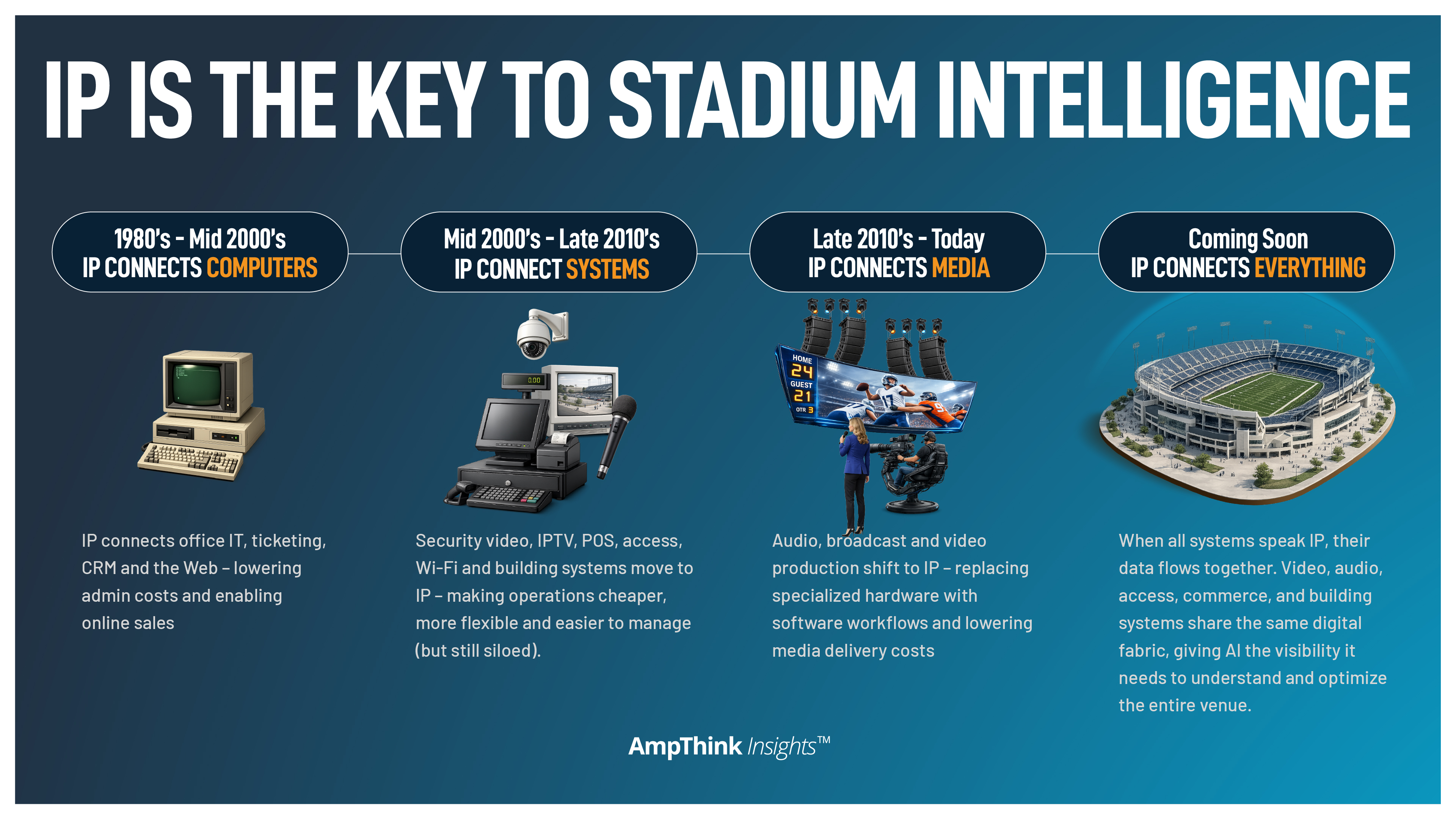
It doesn’t make headlines anymore. But for the better part of 30 years, IP has been steadily spreading through stadiums one system at a time. Only now are we beginning to see that this slow-motion shift may be the real inflection point in stadium infrastructure — and a critical foundation for whatever AI eventually becomes.
AI is only as powerful as the data it can see.
And most of the data that matters in a venue: transactions, movement, video, audio, building controls, content workflows, lives inside systems that historically have not shared data well.
IP doesn’t solve that problem alone. But it does standardize the way data moves, making it dramatically easier to collect, normalize, and analyze information across systems. As owners and operators experiment with AI, whether for operations, safety, service optimization, guest experience, or revenue strategy they discover the same truth:
AI doesn’t work well in fragmented environments.
It works best when the technology is unified, the data is homogenized, and the network is engineered coherently. And the most proven way to achieve that, at scale, is through IP-based convergence.
So, while the industry debates what AI will become inside stadiums, the more important and more strategic question may be: Are venues building the infrastructure foundation required for AI to do anything meaningful at all?
Ampthink would answer this question with a resounding, YES!

Garland, TX 75042