
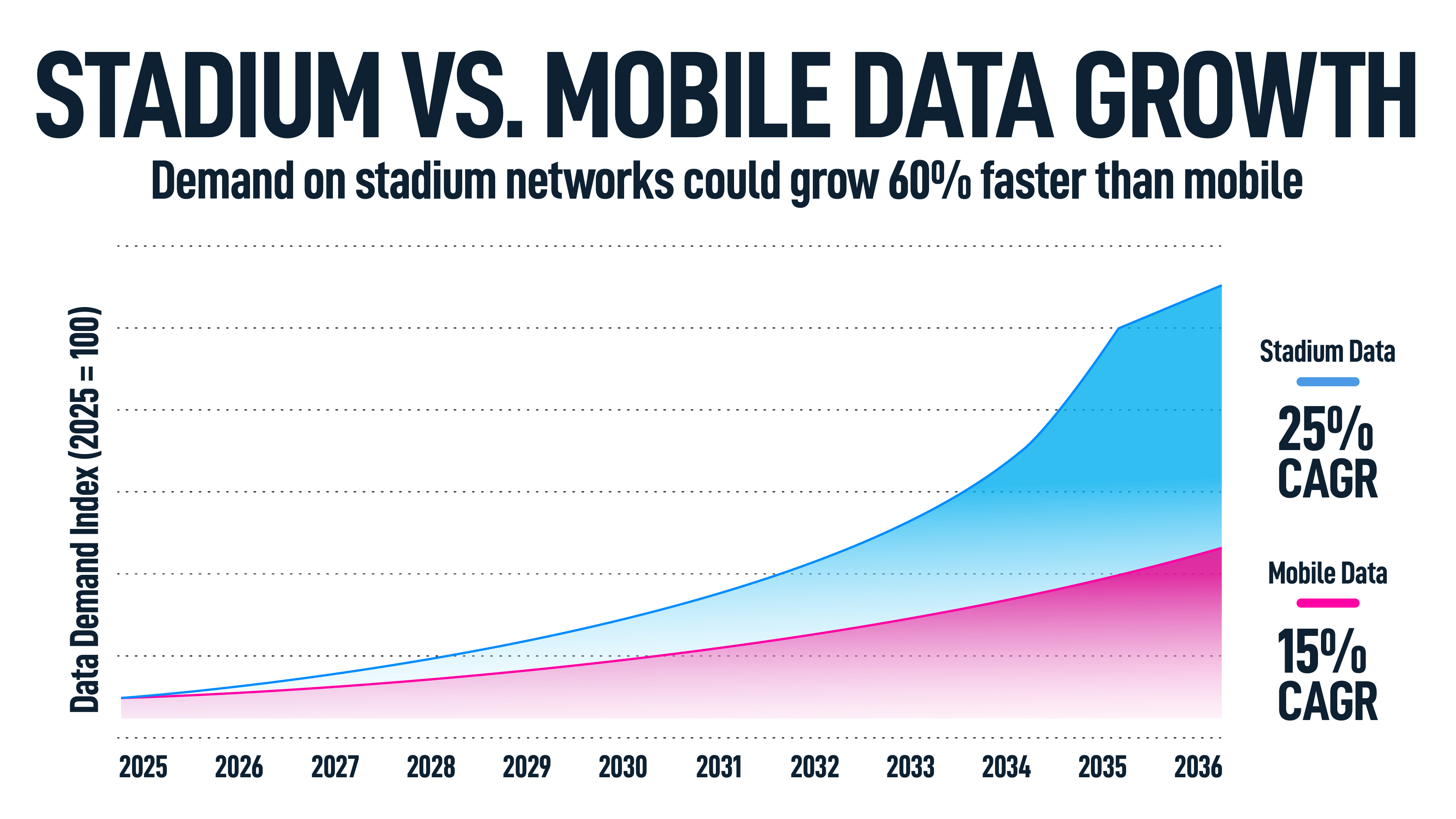
For more than two decades, mobile data demand has grown at a steady and unforgiving pace. Usage has roughly doubled every five years, translating to about 15 percent compound annual growth.
That growth has forced continuous reinvestment by mobile carriers. Networks had to become denser, upgrade cycles shortened, and operating complexity and cost increased year after year. For carriers, compounding data demand became a permanent condition rather than a periodic forecasting exercise.
Stadium networks may now be entering a similar chapter, with one important distinction. The rate of growth could be meaningfully faster.
Looking ahead to the next decade, it is plausible that data demand inside stadiums could grow at 25 percent annually, or about 60 percent faster than mobile. The estimate reflects both projected growth in the number of connected endpoints and a gradual increase in data intensity per device as operational and AI driven systems proliferate. This is not a prediction that fans will suddenly behave differently, but a reflection of how stadiums themselves are changing.
Fan traffic remains an important part of the picture. Mobile usage inside stadiums continues to rise, and that growth is already embedded in venue network planning. What is changing is the layer that runs alongside it. Operational systems are becoming data driven by design. AI assisted security, analytics, automation, building controls, and optimization platforms rely on continuous data flows that do not peak and fade with the crowd. These systems operate before, during, and long after events, adding a persistent source of demand to networks that were originally sized around episodic use.
Mobile networks offer a useful reference point not because stadiums resemble carriers, but because carriers have already experienced what sustained demand growth does to network economics. Under continuous growth, capacity upgrades become routine, operating expenses rise alongside performance expectations, and networks shift from one-time investments to long-term obligations that require ongoing stewardship.
This analysis is not offered as a forecast, but as a signal for long-term planning. If stadiums pursue the efficiency, automation, and experience gains promised by ““smart”” venue strategies, their networks will need to be treated less like static fixtures and more like active infrastructure. Carriers made that shift years ago. Stadium owners will increasingly face the same reality.

Garland, TX 75042