
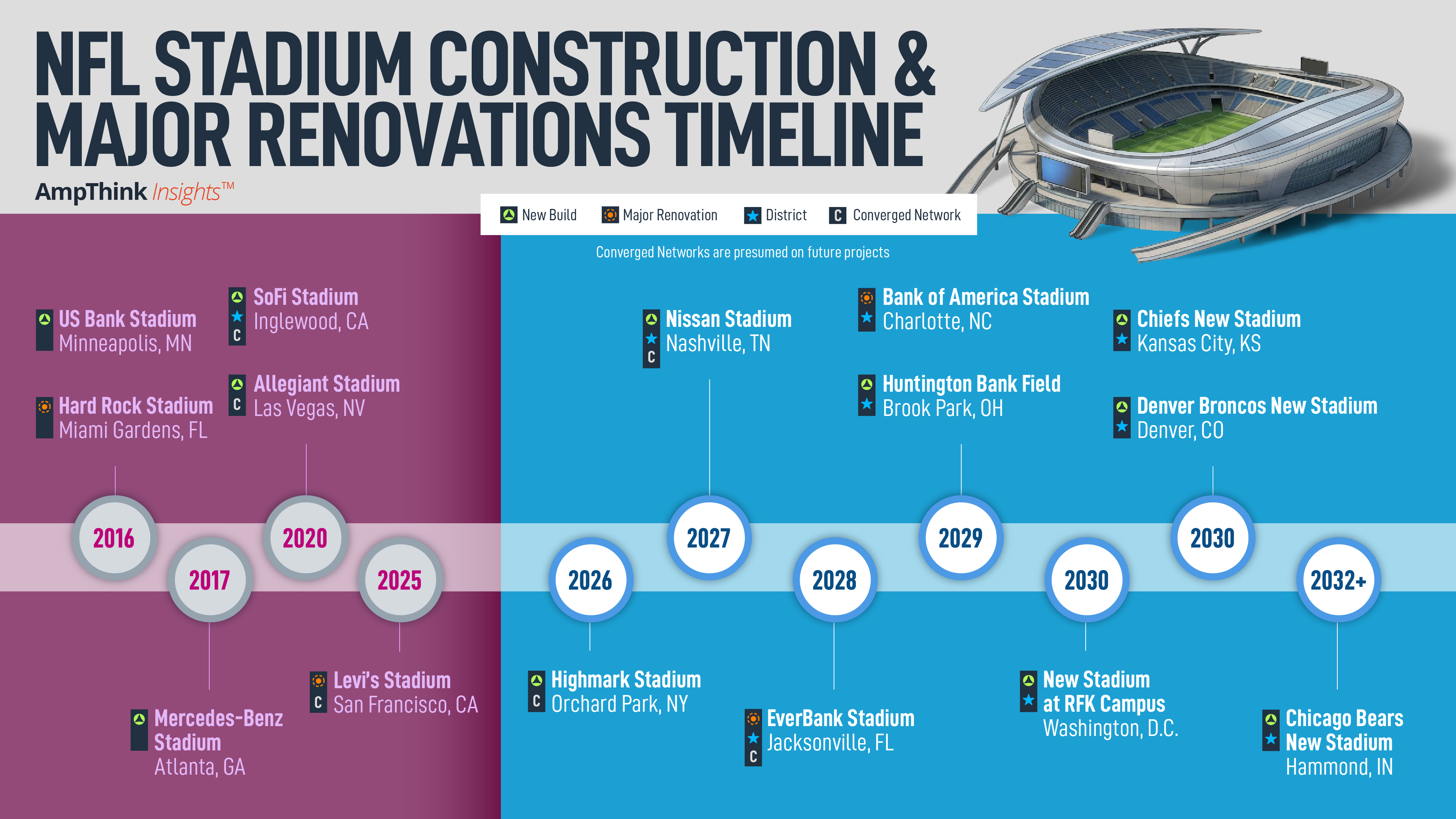
The NFL stadium construction pipeline is accelerating.
Based on projects underway or publicly planned, the next seven years could see nearly twice as many major stadium projects come online as the previous decade, and most are expected to include some form of mixed-use district development.
That is a major shift in stadium strategy.
Owners are no longer thinking only about buildings designed for game-day use. They are treating stadiums as anchors for year-round real estate, entertainment, hospitality, and infrastructure platforms. In this model, the stadium becomes more than a venue. It becomes the anchor tenant for a larger development strategy.
This real estate story is huge news and deserves the attention it is getting, but it is not the only paradigm shift taking shape around public venues today. A second shift is emerging from beneath: technology convergence.
In advanced stadium development, convergence means moving from individually procured, separately managed technology systems to unified, IP-based foundation designed to operate and evolve the venue and the entire district as one system.
Convergence is not simply about putting more systems on the network. It is about creating the infrastructure for a truly smart stadium. In this model, stadium tech construction and operations are more efficient. Building automation and fan personalization become possible at new levels. The venue can be turned more easily, creating incremental revenue opportunities and enabling higher venue utilization.
For owners planning new stadiums or major renovations, convergence is becoming a strategic decision, not just a network design choice. The risk for non-converged venues is not that they won't work. It is that they become harder to adapt, harder to automate, harder to govern, and harder to monetize as the smart stadium and district model matures.
We are not predicting that all future NFL projects will adopt converged networks. But a trend does seem to be growing.

Garland, TX 75042