
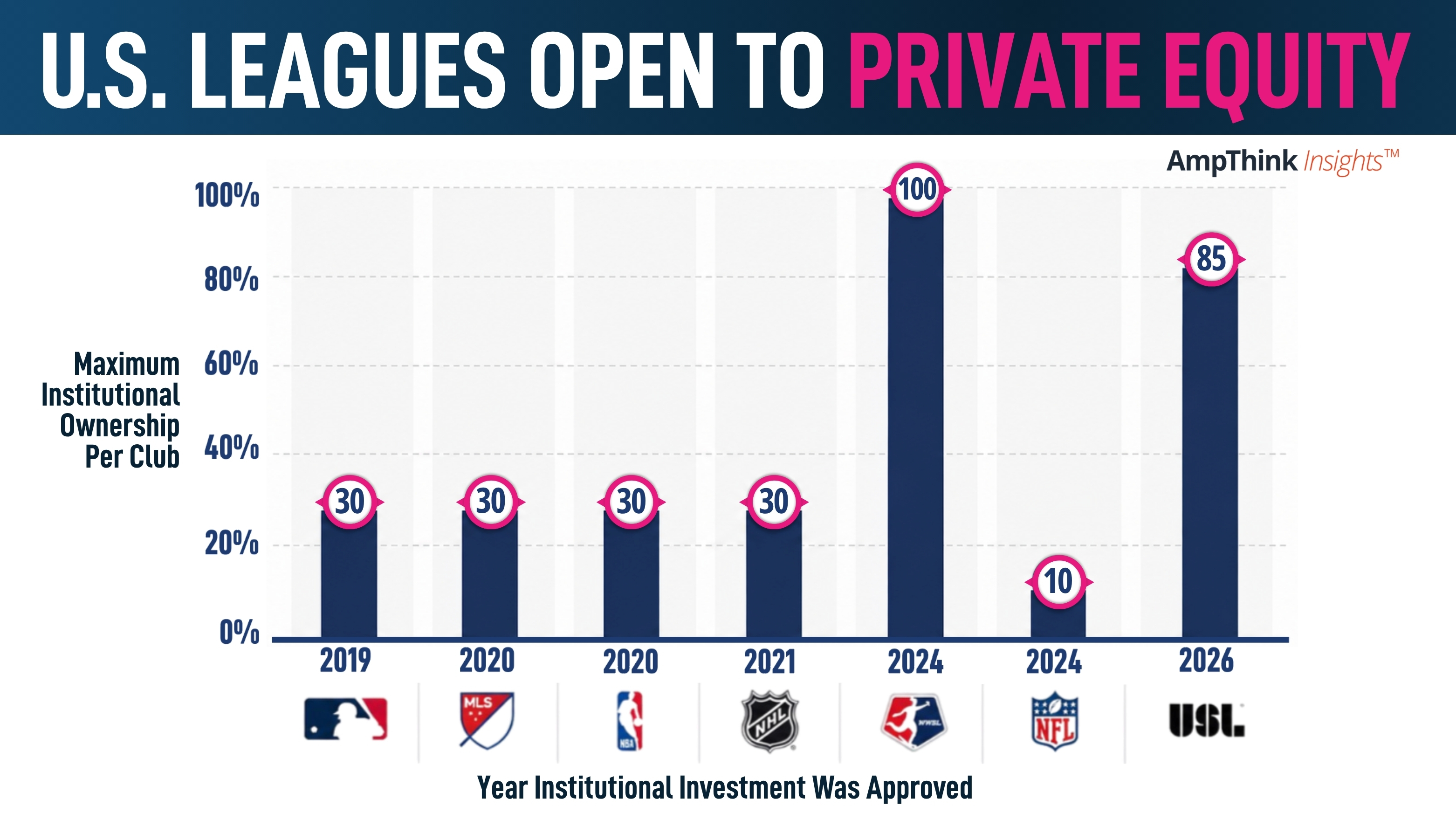
For most of the history of American professional sports, there were certain things an investment fund simply could not buy. A piece of a major U.S. sports franchise was one of them.
Then the rules began to change. MLB opened the door to private equity in 2019. The NBA, MLS and NHL followed, and in 2024 the NFL became the last major U.S. league to allow PE funds into team ownership.
At first glance, this looks like a story about who is allowed to own part of a team. Follow the capital a little farther, though, and a much broader set of questions emerges.
Between 2019 and 2024, private equity firms invested more than $55 billion in sports-related assets, including teams, leagues, media rights, data, technology and fan-engagement businesses.
At the same time, owners are investing billions in a new generation of stadiums and surrounding mixed-use districts. The global smart-stadium market is projected to grow from roughly $23 billion in 2026 to nearly $59 billion by 2033, a 14.5% annual growth rate.
Outside sports, private capital is also pouring into expensive digital infrastructure supporting the growth of AI, particularly data centers. This demonstrates that PE is willing to finance technology infrastructure when it sits at the center of a compelling growth market.
That matters because private equity typically looks for more than asset appreciation. Value creation often comes from revenue growth, better utilization, operating efficiency and stronger margins.
What might that mean for stadiums?
As new stadium and district development accelerates, will owners rethink how technology is financed over the life of the asset? Could the mismatch between a stadium designed to operate for 30 years or more and technology that may need replacement every five to ten years encourage models such as technology as a service?
Will owners become more rigorous about measuring whether technology increases revenue, or reduces operating expenses? Could that favor more converged, automated and digitally operated venues? These questions arise naturally when considering how private equity typically creates value.
Sports may prove different. League rules generally restrict PE funds to minority, non-controlling stakes, so they may have little direct influence over how teams are run. Even so, their larger influence may be on how ownership itself is financed, valued and monetized.
And that could change how owners view the stadium: less as a building that hosts games and more as an operating platform whose utilization, revenue and cost structure can be optimized.
The ownership chart may be the beginning of the story, rather than the end of it.

Garland, TX 75042