
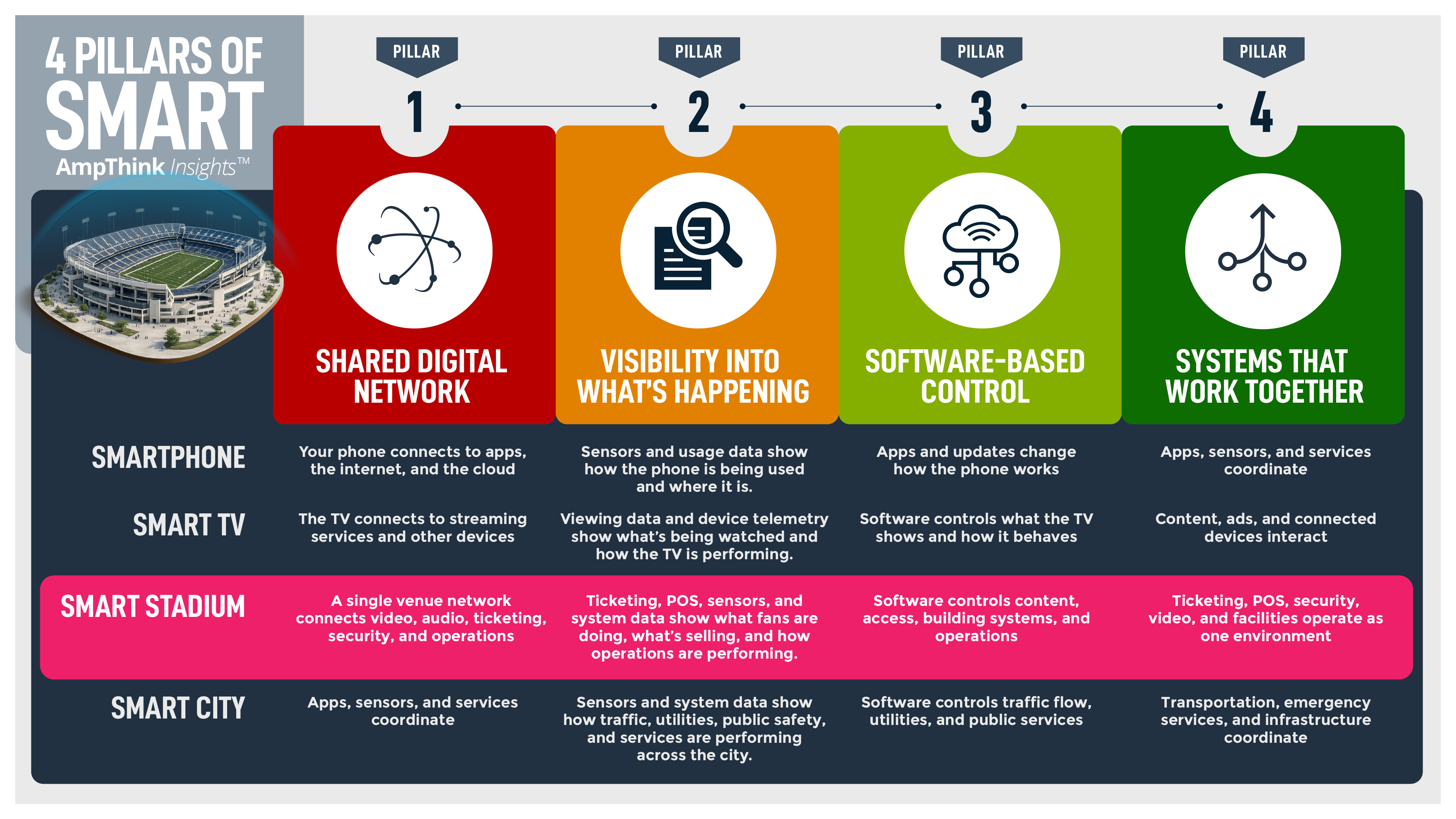
What does it actually mean for a stadium to be “smart”?
Not shiny tech. Not AI. Not apps.
Every truly smart system, whether it’s a phone, a building, or a city, shares four pillars:
Runs on a network; Has real time awareness; Is controlled by software; Interacts in real time with the world around it
These are not buzzwords. They are layers. A network makes data possible. Data creates awareness. Software enables control. Real time interaction creates intelligence.
This is the roadmap from digital to smart. For stadiums, this roadmap is transformative.
When these four pillars come together to form a stadium’s active infrastructure, the venue stops operating on static plans and starts responding to what is actually happening. Fans arrive. Lines form. Weather changes. Games shift. Energy demand moves. Content needs to adapt. Security posture evolves.
A smart stadium can see all of that and respond.
The stadium infrastructure, comprised of myriad components, works as one system. Not one vendor. Not one cable. One live relationship between the building and the world around it.
And that’s why the cliché phrase “smart stadium” actually matters.
Truly smart venues are still rare. But they are the ones that run more efficiently and unlock new revenue opportunities because their infrastructure can adapt. The most profitable venues of tomorrow will be the ones that are becoming smarter today.
Explore the full framework at ampthink.com/ampthink-insights

Garland, TX 75042