
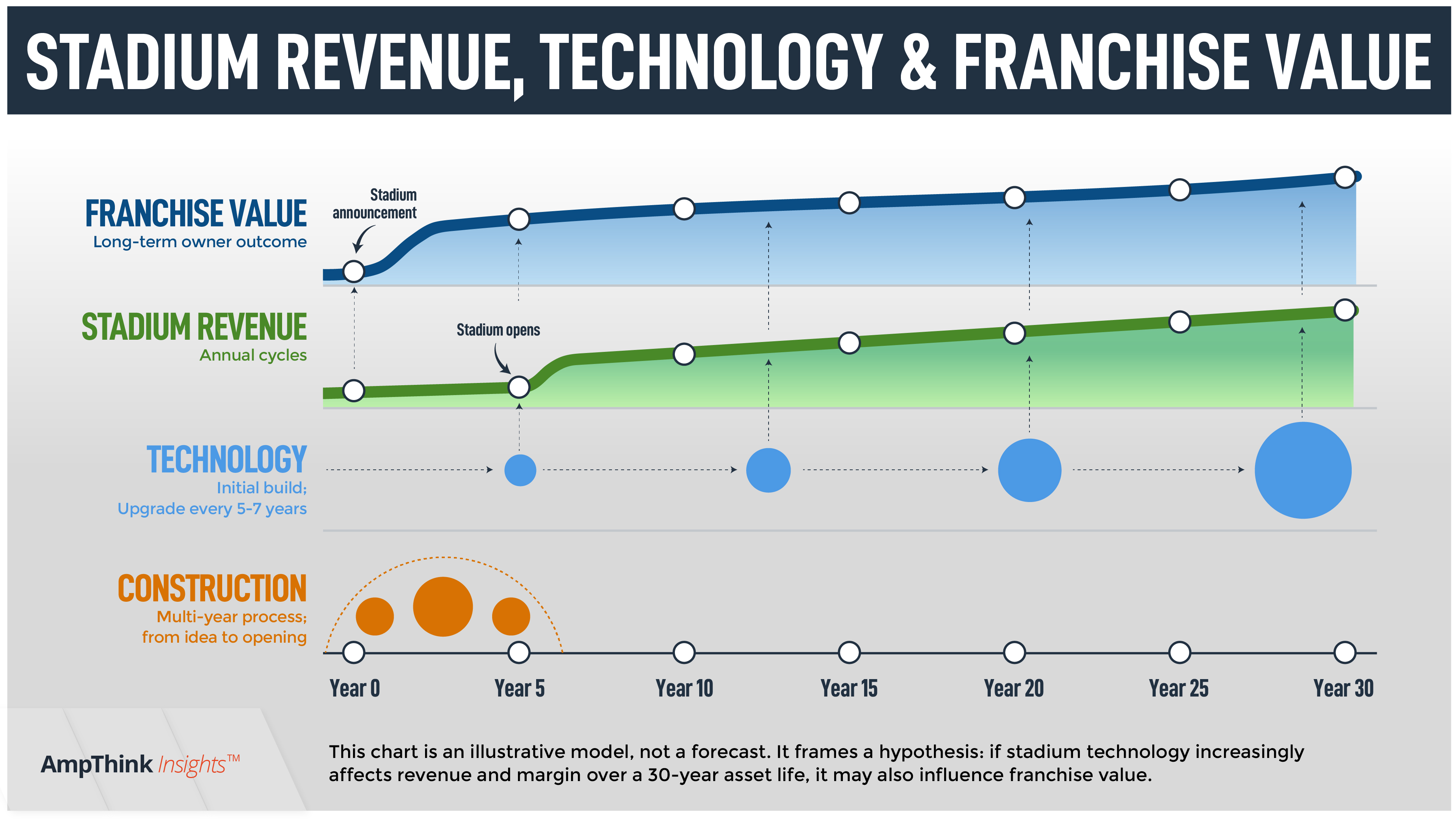
Franchise value is shaped by many forces. Some, like league media rights and market size, sit largely outside an individual owner's control. The stadium is different. It is one of the largest assets an owner can shape, finance, operate, program, and improve.
That is why new venues matter so much to the valuation story. A new stadium can create new revenue expectations through premium inventory, sponsorship assets, major-event potential, hospitality, parking, media, real estate, and district activity. The mere promise of a new venue can change the way investors view the franchise.
But revenue is only one side of the equation. A stadium's contribution to franchise value also depends on how efficiently it converts revenue into durable operating income.
That is where the blue circles in this illustration become important.
The stadium revenue and franchise valuation curves show what the market usually watches. More revenue equates to higher valuation in most cases. The circles represent recurring technology investment over the life of the stadium. They get larger over time because the investment grows, but also because technology becomes more strategically important as the venue matures.
After an initial spike in the early years of a venue opening, revenue growth often slows. Yet expenses continue to rise, and margins can tighten. At that point, technology must do more than support the building's systems. It should help reduce operating friction, enable improved utilization, reduce labor costs, protect margin, and allow the venue to capture incremental revenue as new market opportunities emerge.
The venue's capacity to operate efficiently over the long-haul rests in large part on technology infrastructure decisions made before construction begins. Network architecture is among the most strategic choices venue owners will make. A converged, IP-based core network can reduce duplication, lower lifecycle complexity, and give the owner more control and flexibility in operations, maintenance, and upgrade scenarios. Over the life of the asset, the decision to unify technologies may help determine how much the stadium contributes to franchise value over time.

Garland, TX 75042