
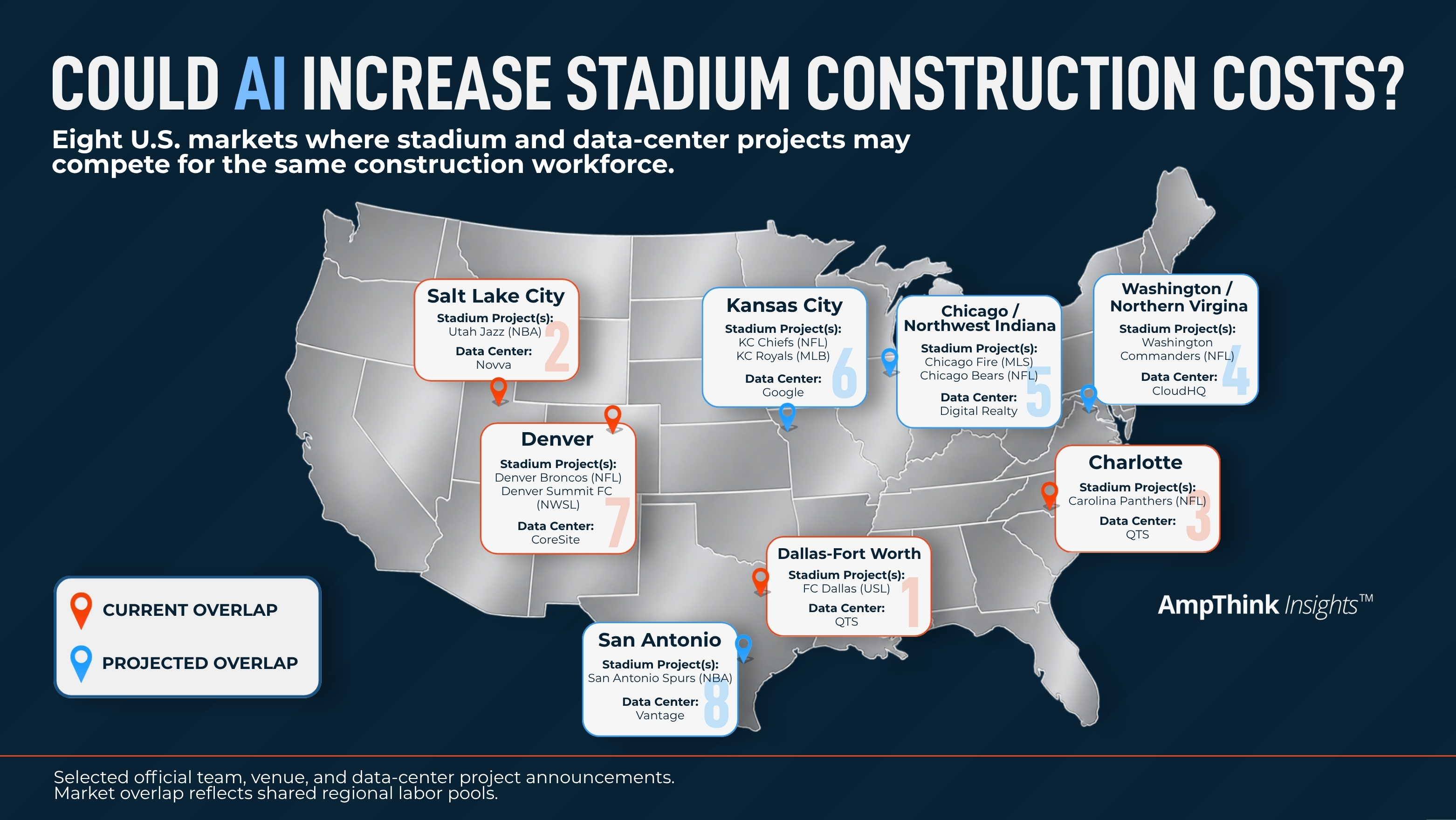
While AI promises long-term productivity, building the physical infrastructure to support it is creating immediate resource constraints across the commercial construction sector.
The collision runs directly through data center pipelines.
This is not a localized issue. Recent data from real estate firms like CBRE and Jones Lang LaSalle (JLL) reveals that data center construction has expanded dramatically, with active pipelines now blanketing every single one of the top 50 U.S. metropolitan economies. Concurrently, developers are planning or constructing specialized mixed-use sports entertainment districts in many of those exact same major markets.
Data center and stadium construction are likely to overlap in many places. The 8 markets shown here are just an illustration of a broader nationwide challenge.
Because data center builds depend heavily on the exact same finite, regional labor pool required to build modern sports venues, the two industries may compete for identical resources.
Consider the current market constraints:
- The Talent Gap: JLL estimates that 2.1 million skilled-trade positions could go unfilled across the U.S. by 2030.
- The Backlog: Contractors with data center exposure carry an average backlog of 12.2 months, compared to 8.3 months for those without it.
- The Local Bottleneck: Construction labor is heavily regional. A venue project in Dallas, Charlotte, or Kansas City competes primarily within its own local boundary for technical talent.
When multi-billion-dollar tech projects enter these same regions, they absorb specialized trades for extended periods, putting upward pressure on local labor availability and final project pricing.
If qualified technical labor is scarce or committed to a nearby hyperscale build, stadium owners could face reduced contractor availability, higher bids, and heightened schedule risks.
While there is no definitive metric showing a fixed percentage increase on stadium costs yet, the regional threat is increasingly clear. For venue owners, mitigating this exposure isn't about predicting labor rates. It's about changing the delivery strategy.

Garland, TX 75042