
Technical debt is a business constraint most stadium owners know exists, but few attempt to quantify.
Because the cost is difficult to see, it is also difficult to manage. Technical debt can appear as additional labor, operating complexity, difficult integrations, redundant systems, proprietary dependencies and technology that becomes increasingly expensive to change. It can also limit the value owners expected technology to produce in the first place.
McKinsey has tried to put scale around the issue. In research involving large enterprises, CIOs estimated technical debt at roughly 20 to 40 percent of the value of their technology estates before depreciation. McKinsey also found that many companies divert more than 10 percent of new-project spending to resolving existing technical-debt issues.
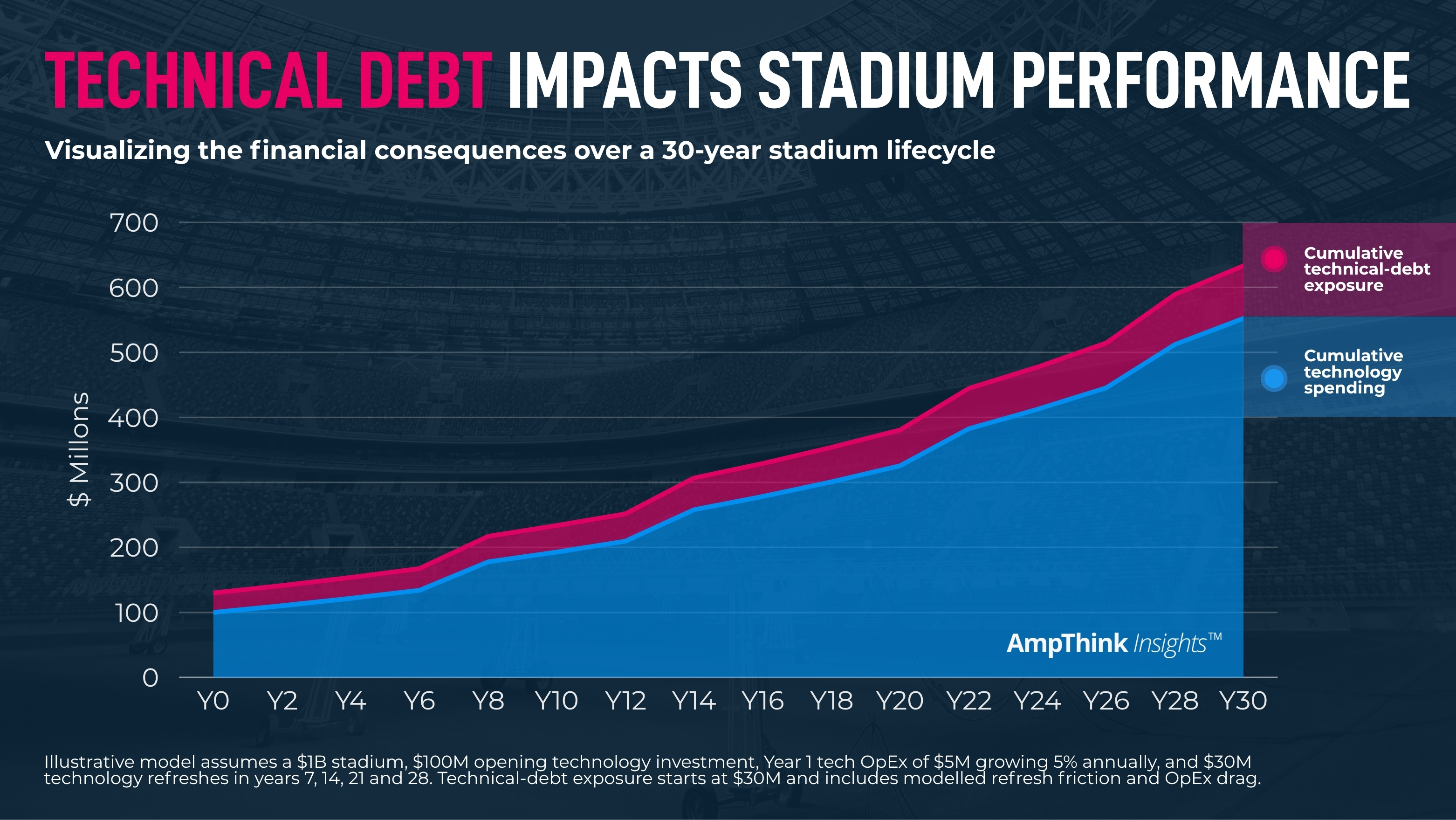
We used that research as a starting point for this illustrative stadium model, not as a stadium benchmark. The model applies a midpoint estimate to a hypothetical $1 billion new stadium with a $100 million technology capex, then layers in modeled operating drag and refresh friction over a 30-year lifecycle.
The important point is the shape of the curve. Technical debt can be present when the building opens, embedded in decisions made during design and construction, then persist and grow as new systems, operating processes and refresh cycles build around those early choices.
That puts greater importance on preconstruction. Owners have an opportunity to reduce the starting level of technical debt while architecture, infrastructure and operating requirements are still being defined. Better coordination across technology, operations, construction, sponsorship and other stakeholders can reduce unnecessary complexity before it becomes part of the building.
We may not yet have an accepted stadium-industry method for quantifying technical debt, but if the potential burden can grow into the tens of millions over a venue's life, it is large enough to warrant a deliberate effort to identify, measure and manage it.

Garland, TX 75042